Your privacy is very important to us. When you visit our website, please agree to the use of all cookies. For more information about personal data processing, please go to Privacy Policy.






HuidaGene Publishes First-in-Human HG302 Study in Cell, Reporting Molecular Activity and Important Safety Findings in Duchenne Muscular Dystrophy


Publication provides clinical and preclinical evidence to inform the safety, therapeutic potential, and future development of systemic in-vivo genome editing
SHANGHAI and MIDDLETOWN (DE), OCT 27, 2026— HuidaGene Therapeutics today announced the publication in Cell of results from HG302-01, an investigator-initiated, first-in-human clinical study evaluating HG302, an investigational CRISPR/Cas-based in vivo genome-editing therapy for Duchenne muscular dystrophy (DMD).
The publication, "In Vivo Genome-Editing Therapy for Duchenne Muscular Dystrophy: Preclinical Studies and First-in-Human Trial," reports preclinical findings and data from four participants treated at two dose levels. The study provides molecular evidence of in vivo genome editing and dystrophin expression in human skeletal muscle, while also documenting a treatment-related fatal serious adverse event and important limitations in predicting and managing severe toxicity associated with systemic AAV delivery.
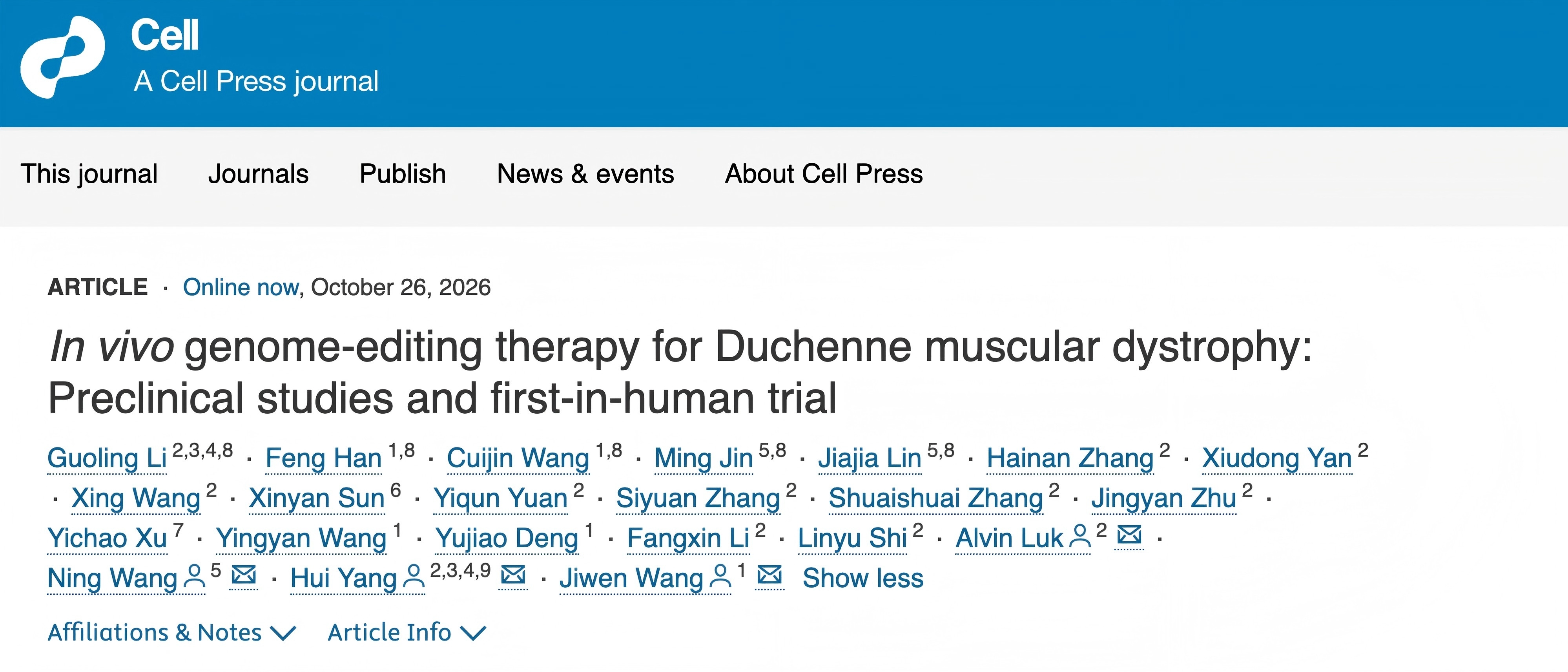
Read the paper: https://www.cell.com/cell/abstract/S0092-8674(26)01206-7
Key Findings:
• First-in-human clinical evaluation: Four ambulatory boys with DMD received a single intravenous infusion of HG302 at either 5.0×10¹³ or 1.0×10¹⁴ vector genomes/kg.
• Molecular evidence of activity: Post-treatment muscle biopsies demonstrated on-target genome editing and detectable dystrophin expression.
• Exploratory functional outcomes: The two participants who completed 12 months of follow-up showed improvements in North Star Ambulatory Assessment (NSAA) scores of 8 and 10 points, respectively, and in 6-minute walk test (6MWT) distance of 106 and 162 meters, respectively.
• Important safety findings: Participant 4, the final participant planned for treatment at that stage, experienced a treatment-related fatal serious adverse event characterized by acute respiratory distress syndrome in the setting of marked complement activation and systemic inflammatory responses. The publication describes the clinical course, safety investigations, and causality assessment.
• Long-term follow-up: Dosing is complete, and the three surviving participants remain in long-term safety follow-up.
• Lessons for future development: The findings underscore the limitations of preclinical models and existing risk-mitigation approaches in predicting and preventing severe immune-mediated toxicity after systemic AAV administration, highlighting the need for continued improvements in safety assessment and clinical monitoring.
About HG302
HG302 is an investigational CRISPR/Cas-based in vivo gene-editing therapy designed to restore dystrophin expression in individuals with DMD. HG302 received Orphan Drug Designation from the U.S. Food and Drug Administration and was evaluated in the HG302-01 first-in-human clinical study.
About Duchenne Muscular Dystrophy
Duchenne muscular dystrophy is a rare, progressive X-linked genetic disorder caused by mutations in the DMD gene, resulting in little or no functional dystrophin protein. The disease primarily affects skeletal and cardiac muscle, leading to progressive muscle weakness and functional impairment. Although available treatments can help manage symptoms and slow aspects of disease progression, none can halt or cure the disease.
About HuidaGene
HuidaGene Therapeutics is a biotechnology company developing genome medicines based on its proprietary HG-PRECISE® platform, with research and clinical programs focused on genetic, neurological, and ophthalmological diseases.
For more information, visit huidagene.com or LinkedIn.
recommendations
-
Dec 12,2024
HuidaGene Therapeutics Initiates M.U.S.C.L.E. Clinical Trial of HG302 for Duchenne Muscular Dystrophy and Completes First Patient Dosed
-
Apr 11,2025
HuidaGene at CRISPR MEDiCiNE 2025: A Celebration of Progress, Promise, and Patients
-
Nov 04,2024
HuidaGene Therapeutics Receives the First-Ever FDA Clearance of CRISPR/Cas13 RNA-Editing HG202 for Macular Degeneration
-
Dec 06,2024
HuidaGene Therapeutics Announced First Patient Dosed in the HERO Clinical Trial of HG204 for MECP2 Duplication Syndrome